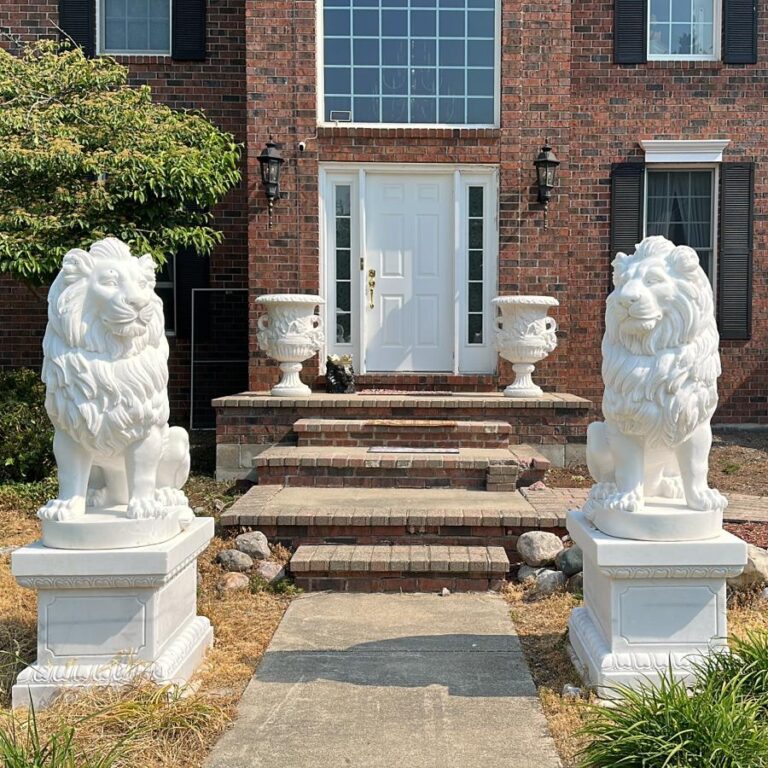

Are you curious about the lion statues at Chinese buildings? They are not just decorations. They hold deep meaning and power, a secret language of protection and prosperity.
In China, lions symbolize protection, power, and good fortune. They are powerful guardians, often placed in pairs at entrances. Their job is to ward off negative energy, evil spirits, and bad luck, while protecting the family or business inside and attracting wealth.
I have been in the sculpture business for more than 20 years. In that time, I've helped hundreds of clients choose the perfect lion statues. It's always amazing to see how these powerful symbols bring a sense of security and grandeur to a home. The meaning behind them is just as important as the stone they are carved from. We are going to explore this symbolism more deeply.
What are the famous Chinese guardian lions1 called?
Have you heard people call them "Foo Dogs2" and wondered if that was right? This common name can be confusing, making you miss the true history of these majestic statues.
Chinese guardian lions are often called "Foo Dogs" or "Fu Dogs" in the West, but in China, they are just "Shi3" , meaning lion. The name "Fu Dog" likely came from the word "Fó" , meaning Buddha, linking them to Buddhism's introduction to China.
Let's dive deeper into the name and the lions themselves. The term "Foo Dog" is almost completely unknown in China. It's a Western name. The connection to Buddha is very important. When Buddhism spread to China, lions were brought as protectors of the dharma (the teachings of Buddha). Since real lions were not native to China, the artists had to create them from descriptions. This is why they often look a bit like dogs, especially the Pekingese, which they resemble.
Over the years, I've explained this to many clients. They come to me asking for "Foo Dogs," and I love sharing this piece of history with them. We then talk about the most crucial part: the pair.
The Male and Female Pair
Chinese guardian lions always come in a pair, a male and a female, representing the balance of yin and yang4.
| Lion Type | Placement (Facing Out) | Object Under Paw | Symbolism |
|---|---|---|---|
| Male | Right Side | A Ball (xìu qiú) | Represents control over the world, power, and supremacy. |
| Female | Left Side | A Cub | Represents nurturing, protection of the family or household. |
This pairing is not just for decoration; it is essential to their function. The male protects the structure itself, the physical building. The female protects the soul of the home, the people inside. When we install these for a client, getting the placement right is the final, vital step.
Why do so many people choose lion statues for their homes?
Your beautiful home is your sanctuary, but does it feel fully protected? Without a symbol of strength at your gate, you might be missing a sense of ancient, powerful security.
People choose lion statues for their powerful symbolism. They act as spiritual guardians5, warding off bad luck and attracting wealth. For many of my clients, it is about adding a layer of both aesthetic beauty and spiritual protection to their most important space.
For centuries, these lions have stood guard. They were once only for the palaces of emperors and the homes of the very wealthy. Having them showed immense status and power. Today, that tradition continues. Placing a pair of lions at your entrance does more than just look good. It makes a statement. It says, "This place is protected."
I remember a client, an overseas Chinese gentleman living in Europe. He contacted us because he wanted to bring a piece of his heritage to his new estate. He chose a magnificent pair of traditional Chinese lions carved from white marble. After we helped coordinate the installation, he called me. He said that for the first time, his new house felt like a true home. He felt a deep sense of peace and security, knowing these guardians were watching over his family. That is the real power of these sculptures. It's not just stone; it's a feeling of safety that goes back thousands of years. As per the user's insight, clients from Southeast Asia and overseas Chinese communities have a special love for these lions. It connects them to their cultural roots, no matter where they are in the world.
Are there different styles of Chinese lion statues?
Do you think all Chinese lion statues look the same? If you do, you might be missing out on finding the perfect style that truly matches your home's personality.
Yes, there are distinct styles of Chinese lion statues, which mainly fall into two categories: Northern and Southern. Northern lions are more realistic and powerful, often found in imperial settings. Southern lions are more stylized, playful, and decorative.
Understanding the difference can help you choose the right lions for your space. At Mily Art, we have been carving both styles for generations, and each has its own special character.
Northern vs. Southern Lions
The styles developed differently based on geography and cultural influences. The lions guarding the Forbidden City6 in Beijing are the most famous example of the Northern style.
| Feature | Northern Style (e.g., Beijing) | Southern Style (e.g., Guangdong) |
|---|---|---|
| Appearance | Muscular, fierce, more realistic | Stylized, often grinning, more playful |
| Feeling | Formal, powerful, serious | Decorative, lively, welcoming |
| Common Use | Imperial palaces, government buildings | Temples, ancestral homes, businesses |
| Details | Simpler, focused on powerful anatomy | Ornate, with ribbons and bells |
I once had a project for a very modern, minimalist villa. The owner wanted the power of the lions but was worried the traditional style would clash. We worked together and designed a pair of Northern-style lions but with sleek, clean lines. We used a dark granite to match the home's facade. The result was stunning. They had the fierce, protective energy, but in a contemporary form. On the other hand, for a client's vibrant garden project in Southeast Asia, we carved a pair of Southern-style lions with very intricate details and a friendly, almost smiling expression. They added a sense of joy and celebration to the space. It shows that no matter the project, there is a lion style that fits perfectly.
Conclusion
In China, lions are far more than just statues. They are powerful symbols of protection, good fortune, and status, with a history as rich as the culture itself.
Explore the deep symbolism and cultural significance of Chinese guardian lions, essential for understanding their role in architecture. ↩
Discover the origins of the term 'Foo Dogs' and its connection to Buddhism and Chinese culture. ↩
Learn about the authentic Chinese term for guardian lions and its significance in cultural context. ↩
Understand the balance of yin and yang represented by the male and female lion pair, crucial for their protective symbolism. ↩
Delve into the concept of spiritual guardians in Chinese tradition and their importance in homes and businesses. ↩
Learn about the historical importance of the lions guarding the Forbidden City and their representation of imperial power. ↩