
Choosing the right marble fountain size is one of the most important steps when planning a garden, estate, hotel, resort, or commercial landscape project.
A fountain that is too small may disappear visually in a large space, while one that is too large can overwhelm the entrance, courtyard, or surrounding architecture.
The right size depends on more than just the available ground area.
You should also consider:
- installation area
- viewing distance
- surrounding building height
- basin diameter
- total fountain height
- landscape scale
- pedestrian or vehicle circulation
- whether the fountain will be viewed from one direction or from several sides
At YouFine, we normally look at the entire setting rather than recommending a fountain based on one dimension alone.
Quick Marble Fountain Size Guide
For early planning, the following ranges can be used as a general reference.
| Installation Setting | Suggested Fountain Scale |
|---|---|
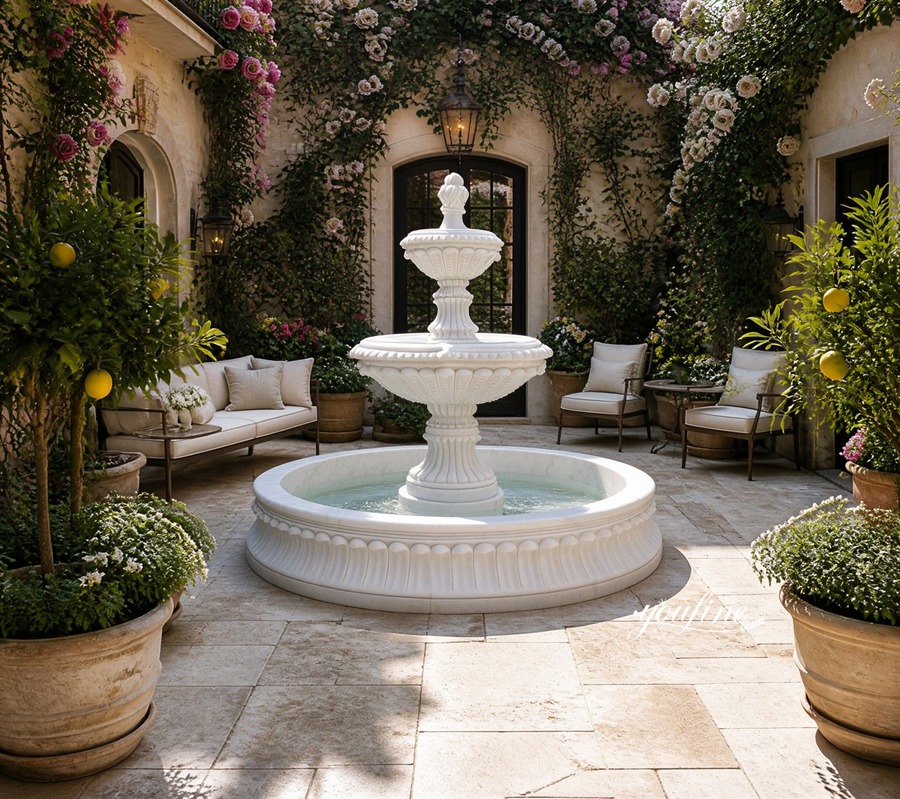
| Small Courtyard | Around 1.5–2.5 m basin diameter |
| Villa Garden | Around 2.5–4 m basin diameter |
| Estate Garden | Around 3.5–6 m basin diameter |
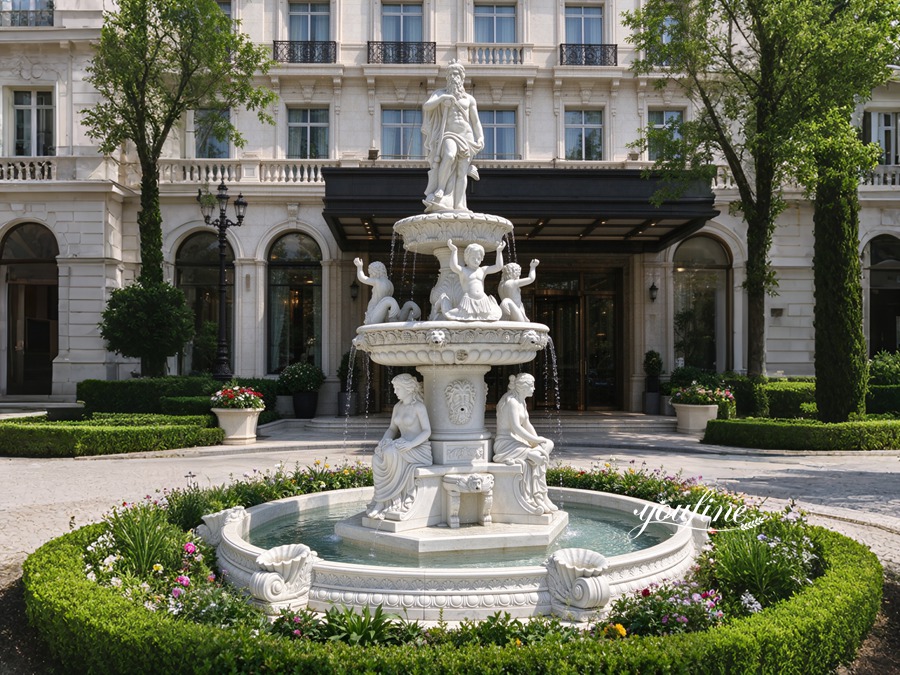
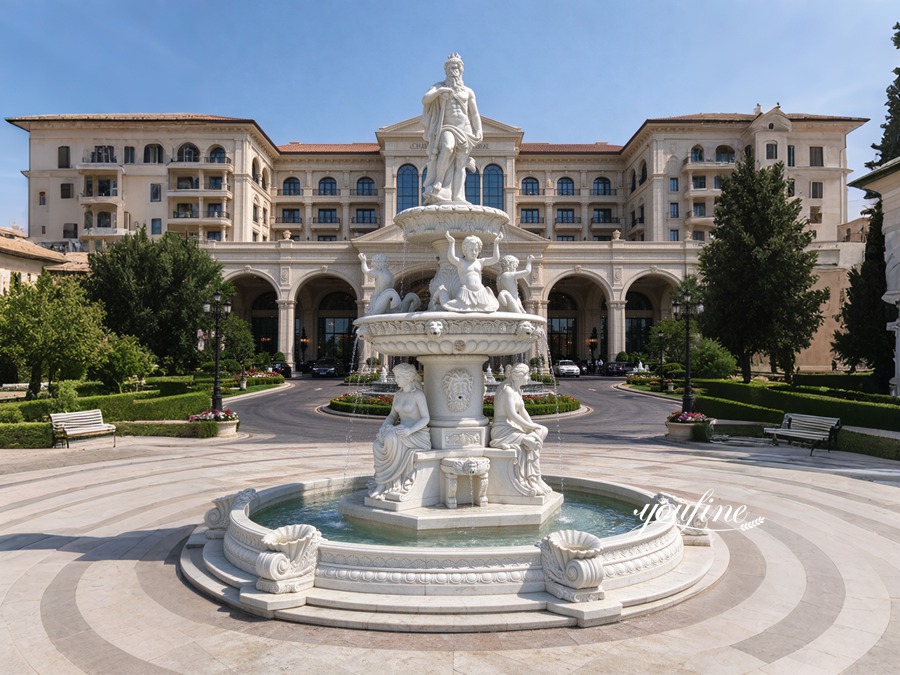
| Hotel Entrance | Around 4–8 m basin diameter |
| Large Plaza / Landmark Space | Around 6 m and above |
These are not fixed rules.
The final size should always be adjusted according to the actual site, building proportions, viewing distance, and desired visual effect.
1. Start With the Installation Area
A small courtyard usually benefits from a fountain that creates a clear focal point without taking over the entire space.
For many residential courtyards, a fountain with a basin diameter of around 1.5–2.5 meters can work well.
Typical characteristics may include:
- one to three tiers
- moderate fountain height
- compact basin
- simple decorative carving
- clear circulation space around the fountain
In a narrow courtyard, the space around the fountain is just as important as the fountain itself.
If the basin is too large, it may make the courtyard feel crowded and reduce walking space.
A smaller fountain with the correct proportions often looks more elegant than an oversized design.
What to Consider
Before choosing the size, check:
- courtyard width
- distance from fountain to walls
- walking path width
- door and window locations
- main viewing direction
Example
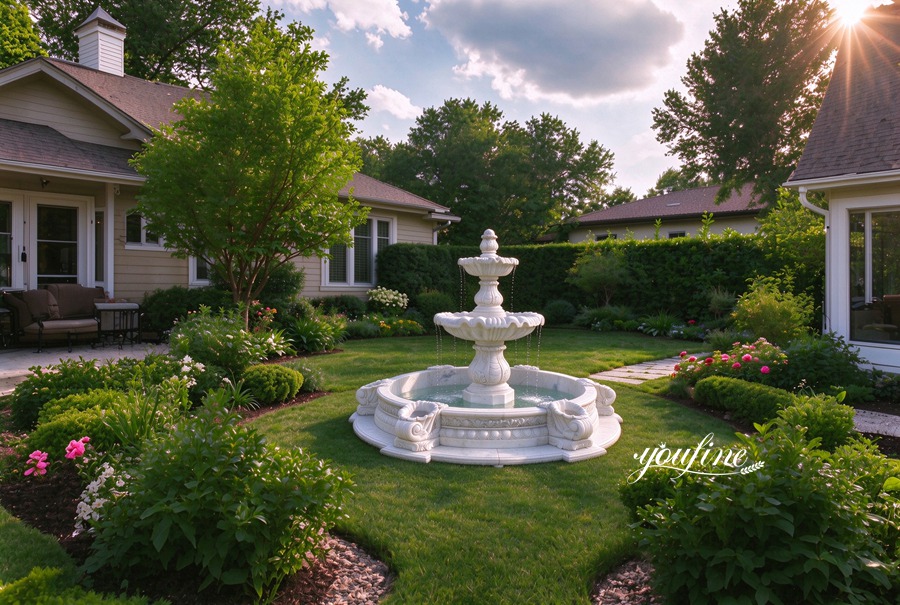
If a courtyard is only around 5–6 meters wide, placing a 4-meter fountain in the middle may leave very little usable space.
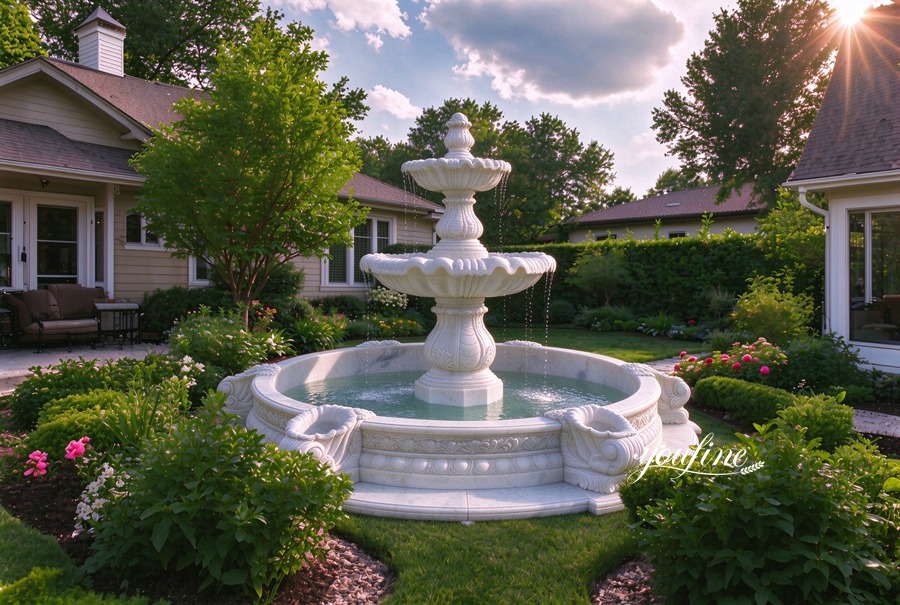
A 1.8–2.2 meter fountain may create a stronger overall result because it allows the architecture, paving, planting, and fountain to work together.
2. Villa Garden Fountain Size
Villa gardens usually offer more flexibility.
For many residential villa projects, a fountain with a basin diameter of approximately 2.5–4 meters works well.
This scale allows the fountain to become an important landscape feature without competing too strongly with the house.
Villa fountains may include:
- two or three tiers
- lion heads
- floral relief carving
- decorative finials
- small statues
- wider bowls
The best size depends heavily on how far away the fountain will be seen.
If the fountain is placed directly beside a terrace, a smaller design may be enough.
If it sits at the end of a long garden axis or driveway, a larger fountain may be needed to maintain visual presence from a distance.
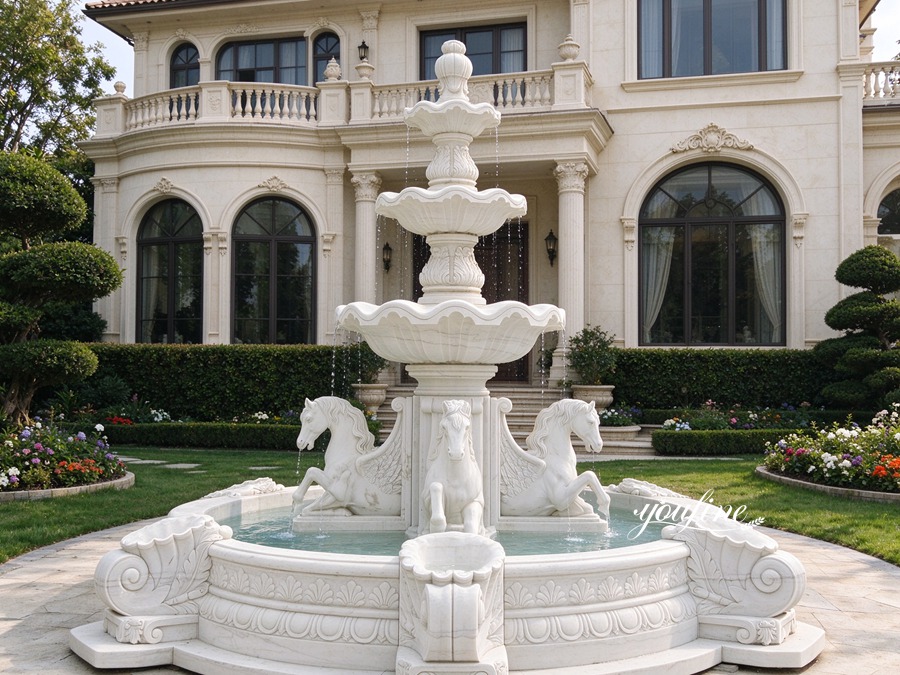
Example
A 3-meter fountain placed 5 meters from the house can appear substantial.
The same 3-meter fountain placed 25 meters away at the end of a large garden may appear much smaller.
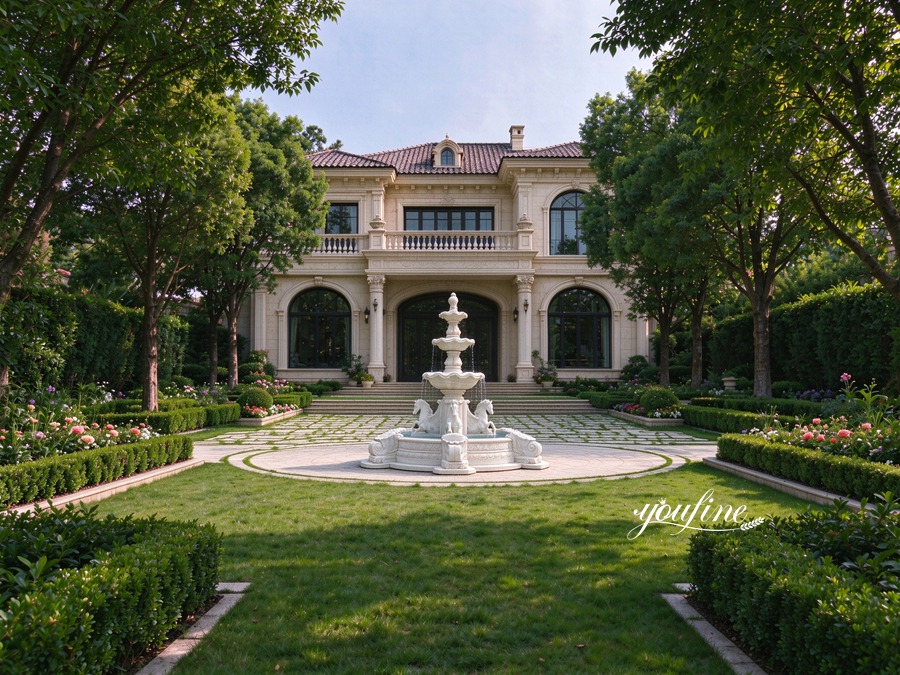
This is why site photos and viewing distance are important when choosing the final dimensions.
3. Estate Garden Fountain Size
Large estates usually require a stronger fountain scale.
For estate gardens, a basin diameter of approximately 3.5–6 meters is common for large visual focal points.
Estate fountains may be placed:
- at the center of a circular drive
- on a formal garden axis
- in front of a mansion
- within a large lawn
- at the center of a courtyard
- near a grand entrance
In these spaces, a fountain needs enough width and height to remain visible from a longer distance.
A very small fountain may look appropriate when viewed from nearby, but almost disappear when seen across a large lawn or driveway.
Design Considerations
For estate projects, we often consider:
- distance from the main house
- width of the driveway
- building façade width
- total building height
- surrounding trees
- lawn size
- whether vehicles circulate around the fountain
A large basin does not always require an extremely tall fountain.
Sometimes a wide, lower composition works better because it creates a strong horizontal relationship with the surrounding architecture.
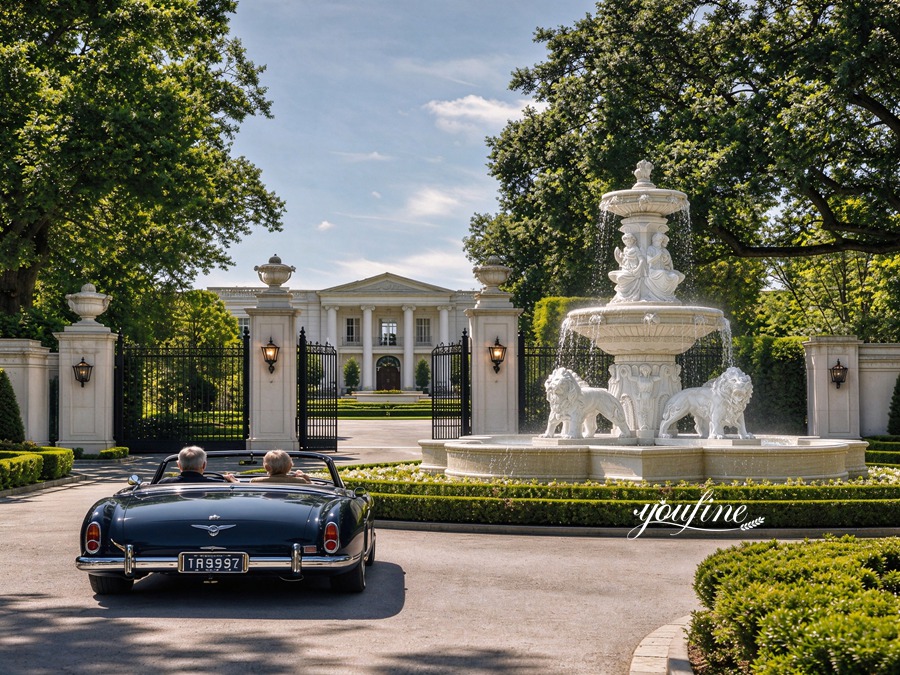
Example
A 5-meter fountain can work well in a large estate garden if it is viewed from 20–40 meters away.
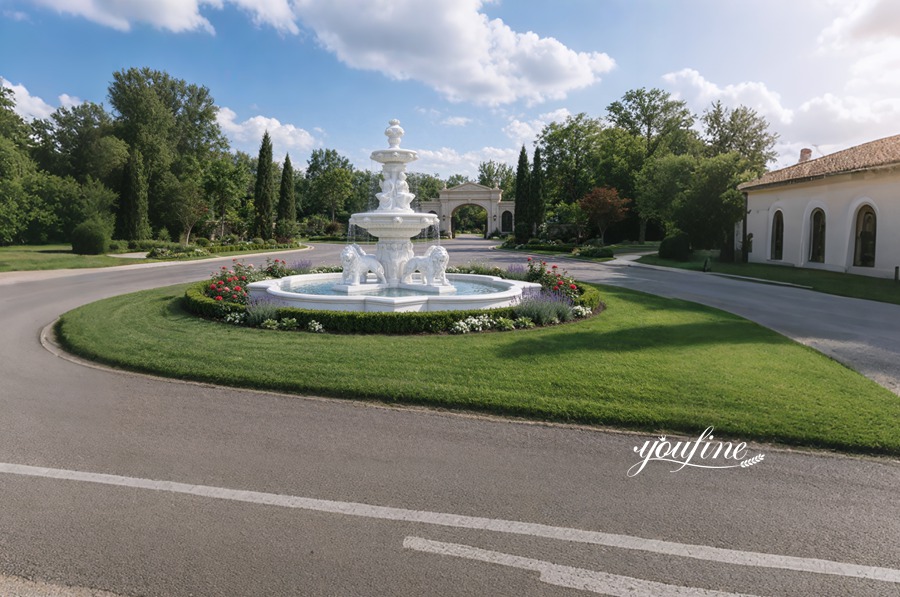
If the same fountain is placed close to a narrow entrance path, it may feel too dominant.
4. Hotel Entrance Fountain Size
Hotel entrance fountains often need to serve both decorative and architectural purposes.
They may need to be visible from:
- arriving vehicles
- drop-off areas
- hotel windows
- entrance doors
- lobby spaces
- surrounding driveways
For this reason, hotel fountains are often larger than private residential fountains.
A basin diameter of approximately 4–8 meters may be appropriate for many hotel and resort entrances.
However, the final scale depends on the building itself.
A large hotel with a wide façade and tall entrance canopy can visually overpower a small fountain.
In this setting, the fountain should have enough height and width to remain proportionate to the architecture.
What to Consider
When selecting a fountain size for a hotel entrance, look at:
- building façade width
- entrance height
- driveway width
- drop-off circulation
- viewing distance from arriving cars
- landscape scale
- pedestrian movement
Example
A 4-meter fountain may work well in front of a boutique hotel.
A large resort with a broad entrance plaza may require a 6–8 meter fountain or a larger custom sculptural composition.
5. Plaza and Landmark Fountain Size
Large plazas, public spaces, and landmark projects require a different way of thinking.
Here, the fountain is often not just a decorative object.
It may become one of the main visual elements of the space.
For large plazas, fountain diameters may start around 6 meters and extend to 8, 10 meters, or more.
Monumental fountains may also combine:
- architectural colonnades
- large human figures
- horses
- mythological scenes
- wide multi-section basins
- multiple water effects
- raised platforms
In large public spaces, the fountain needs to remain visually clear from a considerable distance.
The scale of surrounding buildings also matters.
A fountain placed between multi-story buildings usually needs more visual mass than a fountain placed in an open garden.
Example
An 8-meter fountain may feel large in a private garden but relatively moderate in a wide hotel forecourt or commercial plaza.
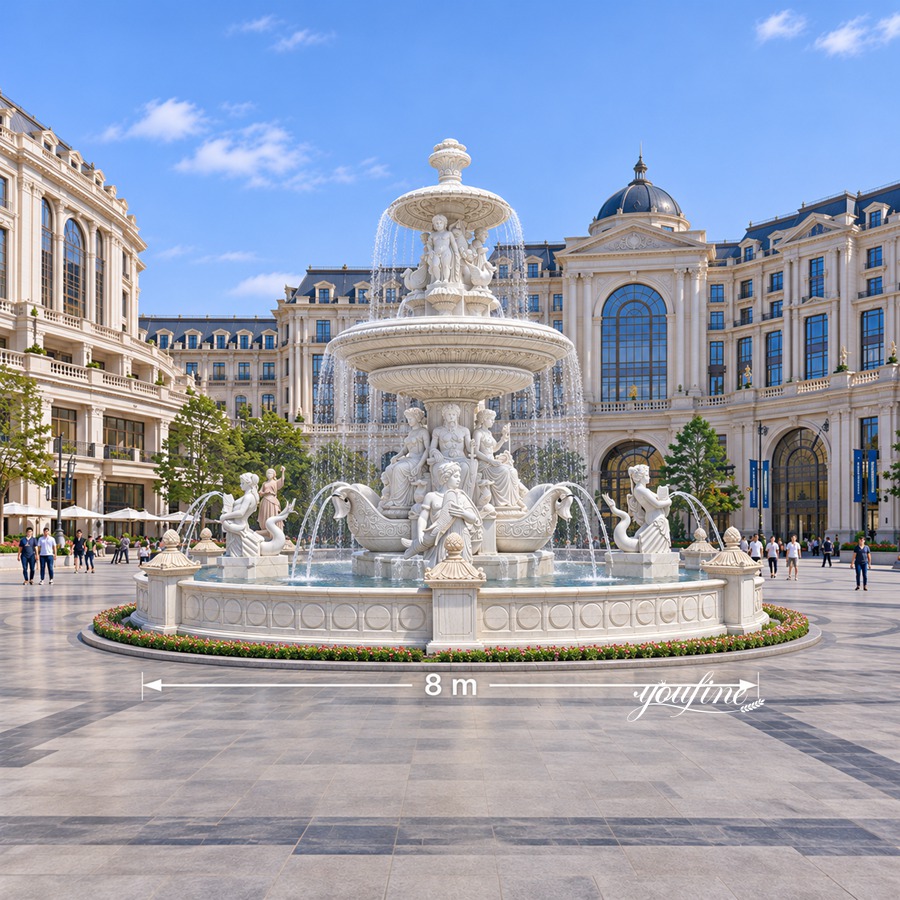
This is why fountain size should always be judged in relation to the entire environment.
Viewing Distance Matters More Than Many Buyers Expect
One of the most overlooked factors in fountain sizing is viewing distance.
A fountain that looks large from 3 meters away may look surprisingly small from 30 meters away.
As viewing distance increases, the fountain normally needs more:
- overall width
- vertical presence
- larger bowls
- stronger sculptural forms
- clearer silhouettes
Fine carving is still important, but at long distances the overall shape matters first.
For example, a highly detailed 2.5-meter fountain may look beautiful from a nearby terrace.
The same fountain may visually disappear at the end of a 40-meter driveway.
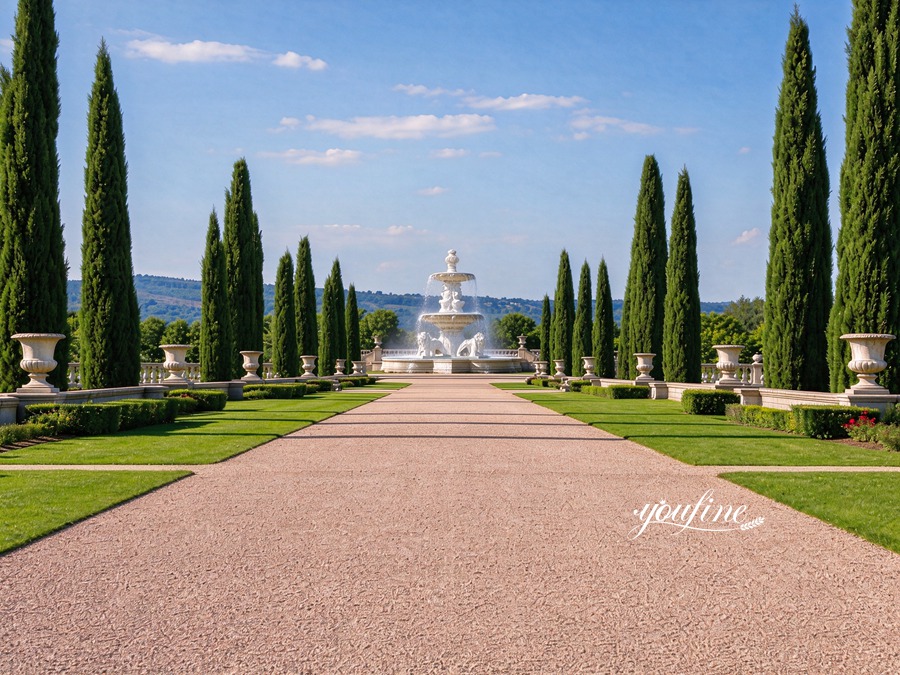
In that situation, increasing the overall fountain scale may be more important than adding additional decorative carving.
Building Height Also Affects Fountain Scale
The surrounding architecture should always be considered.
A fountain installed in front of a one-story villa does not need the same height as a fountain placed in front of a large hotel or multi-story estate.
If the building is visually dominant, the fountain needs enough scale to create balance.
However, this does not mean that the fountain should always be extremely tall.
The goal is proportion.
For example:
- a low, wide villa may work well with a wide but moderate-height fountain
- a tall hotel entrance may benefit from a stronger vertical fountain
- a large château façade may require both width and height
- a courtyard surrounded by high walls may need a more compact but vertically noticeable design
The fountain should feel connected to the architecture rather than looking like a separate object placed in front of it.
Basin Diameter vs. Fountain Height
When choosing the right size, basin diameter and fountain height should be considered together.
Basin Diameter
The basin determines the physical footprint of the fountain.
It affects:
- how much ground space the fountain occupies
- circulation around the fountain
- overall visual weight
- splash containment
- relationship with surrounding paving
A wider basin usually makes the fountain feel more substantial.
Fountain Height
The total height determines the vertical presence.
It affects:
- visibility from a distance
- relationship with building height
- overall elegance
- water drop
- number of possible tiers
However, making the fountain taller without increasing the basin can make the proportions look narrow.
Likewise, an extremely wide basin with a very short center structure can sometimes feel visually flat.
The best design balances both.
A Practical Fountain Proportion Rule
There is no universal formula that works for every fountain.
However, when evaluating a design, we usually look at the relationship between:
basin diameter + total height + viewing distance + surrounding architecture
For example, two fountains may both have a 4-meter basin.
One may be relatively low and wide for a classical courtyard.
Another may use taller bowls and figures for a hotel entrance.
Both can be correct because they serve different spaces.
This is why YouFine does not recommend selecting a fountain from diameter alone.
Should the Fountain Fill the Entire Available Space?
Usually not.
A common mistake is measuring the available area and choosing the largest fountain that can physically fit.
For example, if a circular space is 6 meters wide, this does not necessarily mean you should install a 5.5-meter fountain.
You may also need room for:
- walking
- maintenance
- planting
- lighting
- drainage
- visual breathing space
- crane or equipment access during installation
The fountain should occupy the space comfortably rather than completely fill it.
How Much Space Should Be Left Around a Marble Fountain?
There is no single fixed distance because each project is different.
However, you should consider the fountain as part of a larger landscape composition.
For residential spaces, leaving visible paving or landscape around the basin can make the fountain feel more intentional.
For circular driveways, there should also be enough clearance for vehicle movement.
For hotels and public projects, pedestrian circulation and maintenance access become more important.
When possible, we recommend sharing the full site dimensions rather than only the maximum fountain diameter.
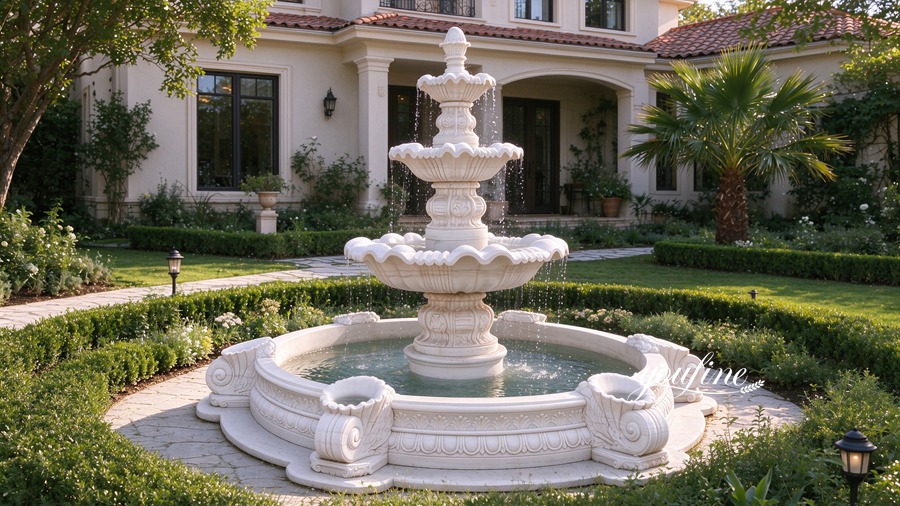
Illustrative Sizing Example 1: Villa Garden
For a villa garden, a client may initially choose a fountain based only on the product photo.
However, after comparing it with the installation area, the fountain may need to be enlarged or reduced.
For example, a 3-meter fountain may work well in a medium villa garden where it can be viewed from approximately 10–20 meters away.
The same fountain may appear too small in a much larger estate garden.
In this situation, increasing the basin to around 4–5 meters can create a better visual relationship with the landscape.
Illustrative Sizing Example 2: Large Estate Entrance
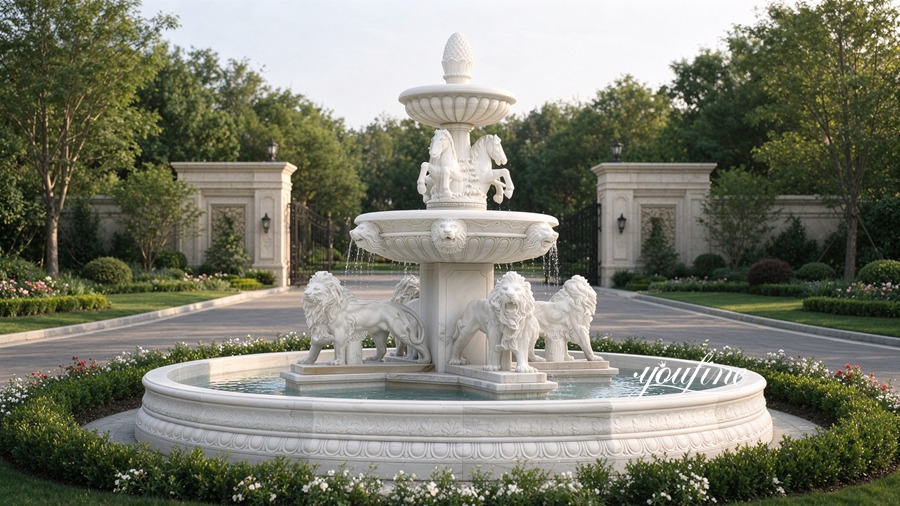
At a large estate entrance, the fountain may need to be visible from approaching vehicles.
A compact fountain can disappear behind planting, cars, or surrounding architecture.
For this type of project, a fountain in the 4–6 meter range may provide a stronger focal point.
The design may also use larger bowls, taller central structures, or sculptural details that remain visually clear from a longer distance.
Illustrative Sizing Example 3: Hotel or Resort Entrance
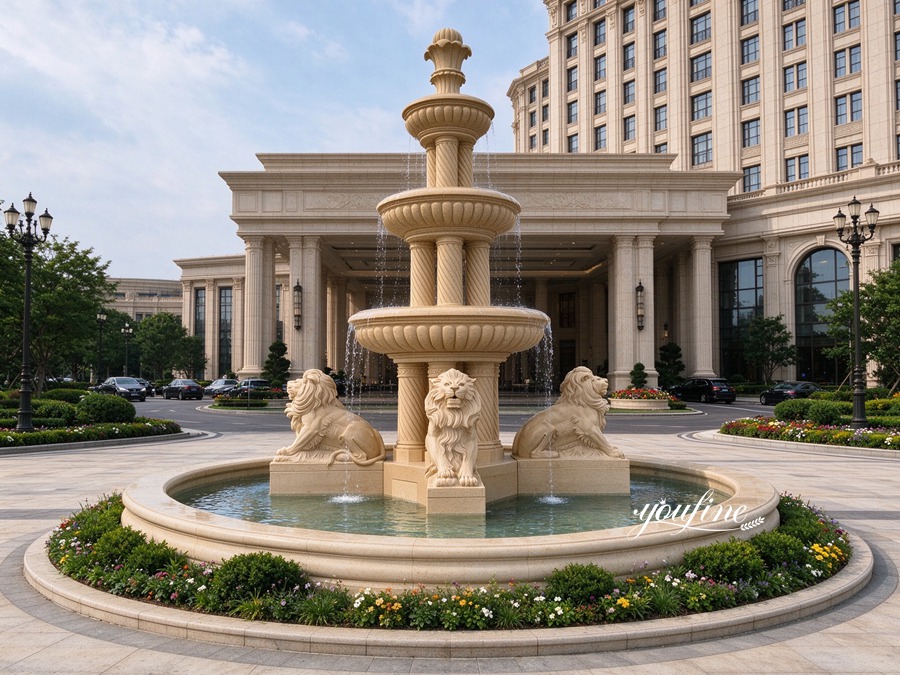
For a hotel entrance, the fountain often needs to relate to a large façade and wide vehicle circulation area.
A fountain around 5–8 meters may be more appropriate depending on the scale of the building.
For especially large resort or commercial projects, the fountain may become an architectural composition rather than a standard tiered fountain.
In these cases, the design may include:
- several figures
- wide basins
- columns
- decorative walls
- multiple water outlets
The final size should be determined from the site plan and entrance proportions rather than from a standard product dimension.
Illustrative Sizing Example 4: Large Plaza
For an open plaza, a fountain with a diameter of 8 meters or more may be appropriate.
The main challenge is not simply filling the space.
The fountain must remain visually strong when viewed from multiple directions and from a long distance.
This usually requires:
- larger sculpture groups
- stronger silhouettes
- wider basins
- more architectural structure
- clear overall composition
In a plaza, scale and visibility often matter more than very fine detail alone.
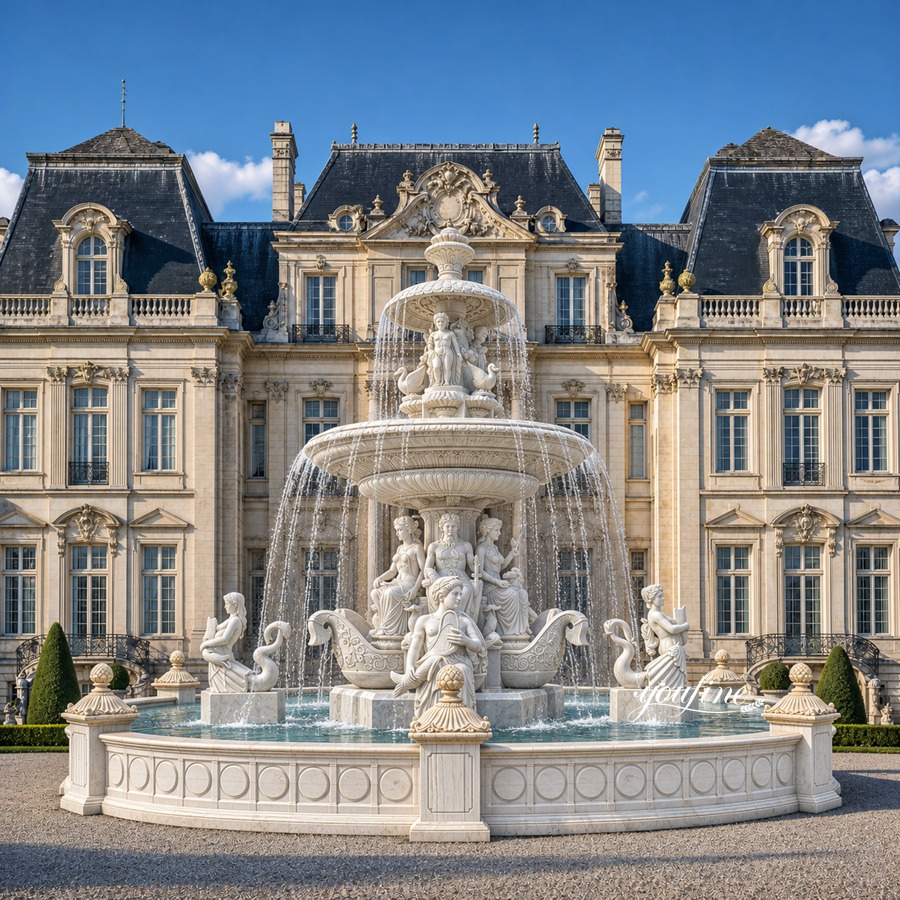
What Size Fountain Should I Choose if I Am Still Unsure?
If you do not know the correct size, you do not need to decide before contacting us.
The most useful information is:
- overall site width
- overall site length
- building height
- distance from the main viewing point
- photos of the site
- preferred fountain style
- approximate budget
With this information, we can discuss suitable basin diameters and total fountain heights.
In many projects, site photos are just as useful as drawings during the early selection stage.
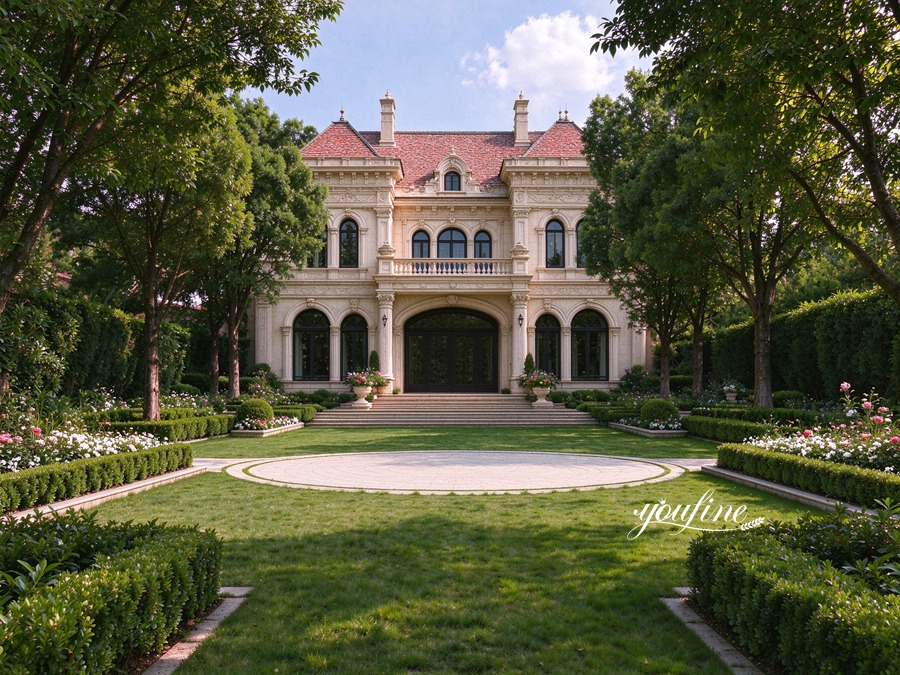
What Information Should You Send for a Fountain Size Recommendation?
To help evaluate the fountain scale, send:
- site width
- site length
- distance from the fountain position to the main building
- approximate building height
- photos of the installation area
- the fountain design you like
If the fountain is planned for a hotel entrance, estate driveway, or plaza, a simple site plan is also very useful.
We can then discuss:
- suitable basin diameter
- suitable fountain height
- number of tiers
- statue scale
- overall proportions
Final Marble Fountain Size Guide
For quick reference:
Small Courtyard
Around 1.5–2.5 m basin diameter
Best for compact private spaces and smaller enclosed gardens.
Villa Garden
Around 2.5–4 m basin diameter
Suitable for residential gardens, terraces, and villa landscapes.
Estate
Around 3.5–6 m basin diameter
Better for larger lawns, formal gardens, and circular drives.
Hotel Entrance
Around 4–8 m basin diameter
Useful where the fountain needs to relate to a larger façade and vehicle approach.
Plaza or Landmark Project
Around 6–10 m+
Suitable for major public, commercial, resort, and landmark spaces.
These ranges are only general references.
The right size depends on the actual site.
Get a Marble Fountain Size Recommendation
Choosing the correct fountain size is not only about finding a design that fits physically.
The fountain should also fit the architecture, viewing distance, landscape, and overall scale of the project.
If you are planning a marble fountain, send YouFine:
- photos of the site
- overall site dimensions
- approximate building height
- a fountain design you like
We can then discuss a suitable basin diameter and total fountain height for your project.
If you already know the approximate size, we can also help adjust an existing fountain design to better fit the installation area.
Planning a marble fountain project? Send us your site photos and approximate dimensions to discuss the right fountain scale for your space.