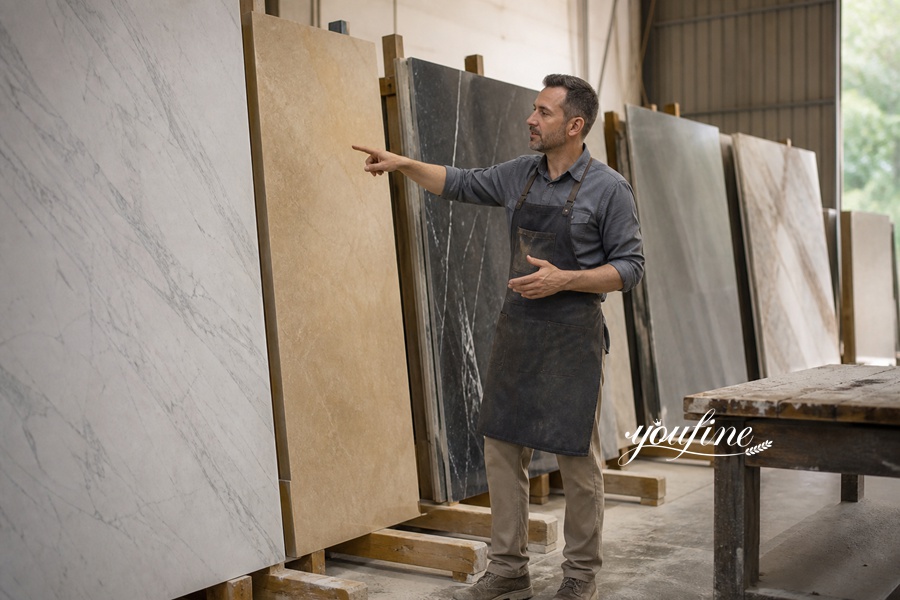

1. Is Carrara the Best Marble for Sculpture?
Carrara is one of the world’s most famous sculptural marbles, and for good reason. Its fine grain, workability, and long history make it an excellent choice for detailed figurative sculpture.
But Carrara is not automatically the best choice for every project.
A museum-quality indoor bust has very different requirements from a large outdoor garden statue. A fountain faces different demands from an interior sculpture. Budget, carving detail, appearance, climate, and maintenance can all affect which stone makes the most sense.
So the better question is not “Which marble is the best?” but “Which marble is best for this particular sculpture?”
Carrara is extraordinary — no one denies it. But “the best marble” does not exist in a vacuum. The best marble for a museum-quality indoor bust may not be the best choice for a garden sculpture exposed to rain and freezing temperatures. Likewise, a classical figure, a modern abstract sculpture, and an architectural element may each benefit from different stone characteristics.
The real question is not “Which marble is the best?” but “Which marble is best for my project, my budget, and my location?”
That is the question this guide answers. Our recommendations are based on decades of experience sourcing, carving, and installing natural stone for sculptural and architectural projects. The lesson we have learned is simple: the stone should fit the project, not the other way around.
Quick Answer: Which Marble Should You Choose?
| Your project | A good starting point |
| Large outdoor white sculpture | Masha White |
| Outdoor figurative sculpture | Guangxi White |
| Fine-detail figurative sculpture | Fangshan White/Carrara |
| Premium indoor sculpture | Carrara |
| White marble with expressive veining | Arabescato / Da Hua Bai |
| Warm-colored outdoor architecture | Egyptian Beige |
| Modern black sculpture | Nero Marquina |
| Maximum outdoor durability | Granite |
These are starting points rather than universal rules. The final choice should also consider the specific stone grade, climate, finish, sculpture size, and carving requirements.
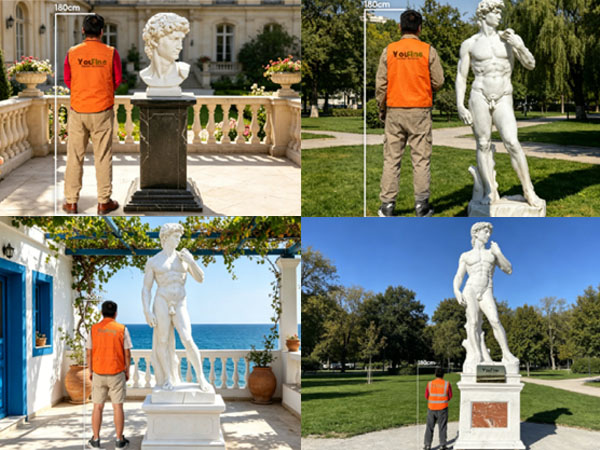
2. The Four Factors That Determine Your Marble Choice
Before you look at a single stone sample, answer these three questions. They will narrow your options by 80% immediately.
Factor 1: Where Will the Sculpture Be Placed?
This is the single most important filter.
·Indoor sculptures: Environmental exposure is usually less demanding, so you can place greater emphasis on appearance, color, veining, translucency, grain, and carving detail.
·Outdoor sculptures: Weather exposure becomes an important consideration. Rain, moisture, sunlight, pollution, salt, and freeze-thaw cycles can affect natural stone differently depending on its composition, porosity, finish, installation, and local climate.
For exposed outdoor sculpture, durability should be considered alongside appearance and carving performance—not simply prestige or price.
Rule of thumb: if it goes outside, prioritize density and hardness over prestige.
Factor 2: How Much Detail Does the Sculpture Require?
A highly detailed portrait or classical figure places different demands on the stone than a large abstract sculpture or architectural element.
For portraits, faces, hands, hair, and delicate drapery, a consistent fine-grained stone can be especially valuable because it allows the carver to work with greater precision.
For large outdoor pieces, structural requirements, stone consistency, and weather exposure may become more important than extremely fine detail.
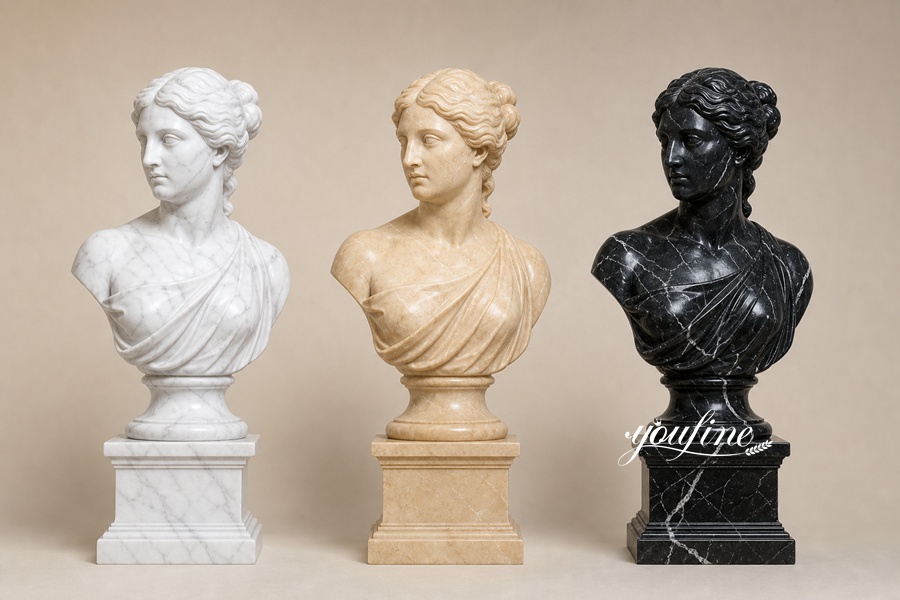
Factor 3: What Appearance Do You Want?
Marble is not only about hardness or durability. Color, grain, veining, and surface finish have a major effect on how the finished sculpture looks.
Do you want a clean white figure? A warm beige tone? Dramatic black-and-white veining? Or a contemporary grey or colored stone?
The answer can narrow the material choice as much as the sculpture’s location does.
Factor 4: What Is Your Budget?
Budget matters, but sculpture price is not determined by stone alone. Size, carving complexity, craftsmanship, stone grade, finishing, shipping, and installation can all significantly affect the final cost.
As a general starting point, more budget-friendly Chinese marbles can offer strong value for outdoor and decorative sculpture, while premium Italian marbles may be chosen when a particular appearance, provenance, or carving tradition is important.
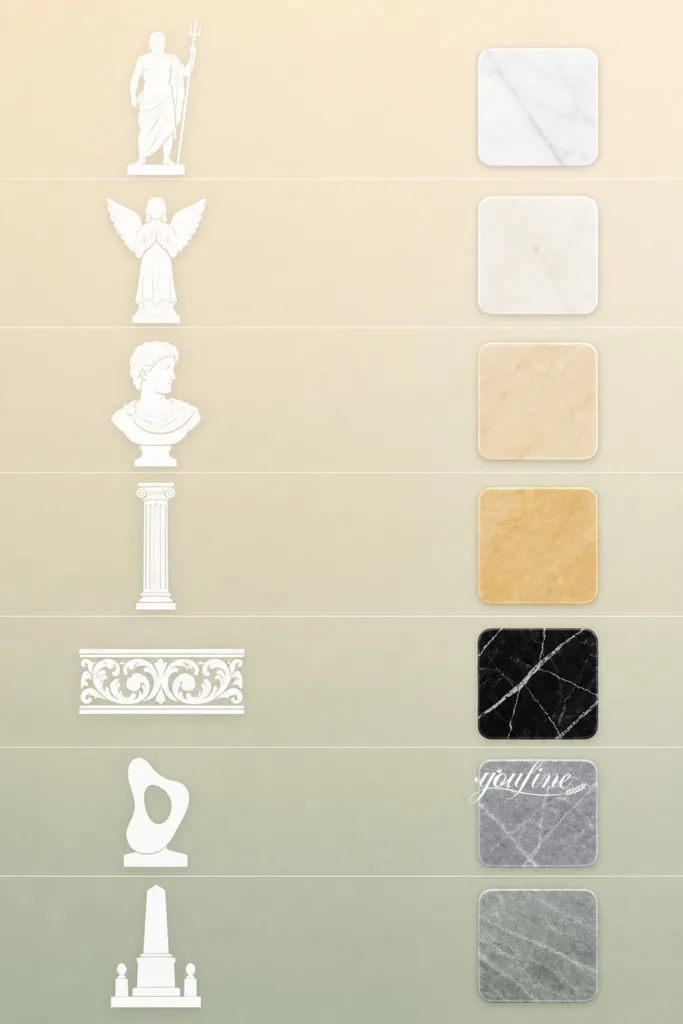
3.What Type of Sculpture Are You Buying?
Match the Stone to the Sculpture:
| If You Want… | Marble Priority | Why |
| A highly detailed portrait bust | Fine, consistent grain | Fine features require precise carving |
| A large outdoor statue | Density, consistency, weather suitability | The stone must perform well in its environment |
| A garden fountain | Appropriate density and water resistance | Constant moisture requires careful material selection |
| A religious statue | Clean color and visual consistency | A restrained appearance may better suit the setting |
| A modern/contemporary piece | Bold color or expressive veining | Pattern can become part of the design |
| An architectural element | Consistency, durability, and suitable finish | Large surfaces make variation more noticeable |
4. Marble, Granite, Sandstone: Know What You Are Buying
A quick but important note before the cards: stone is not just about color — hardness matters too. Two stones can look nearly identical yet behave completely differently under the chisel and under the weather.
Color alone does not tell you what a stone is. Marble, granite, sandstone, and travertine can all appear in similar colors, but they behave differently during carving, finishing, and outdoor exposure.
Marble is generally valued for its workability and its ability to support detailed carving. Granite is significantly harder and is widely valued for outdoor durability, although that hardness can make carving more labor-intensive. Sandstone has a more naturally textured, earthy character and is often chosen when texture matters more than highly polished, fine-detail carving.
The important question is not simply “What color is this stone?” but “What stone is it, and what grade or variety is it?”Sandstone is a sedimentary rock with a warm, grainy texture and a soft, weathered look.
5.The Most Useful Marble and Stone Options for Sculpture
White Marbles
1. Masha White— A Strong Option for Outdoor White Sculpture

| Origin | China |
| Appearance | Bright white with a fine, relatively uniform grain. |
| Outdoor suitability | A strong candidate for exposed outdoor sculpture when the specific material and installation are appropriate. |
| Best for | Large outdoor sculptures, garden statues, and monumental white figures. |
| Price level | $–$$ |
Insider note: For large outdoor projects where you want a white sculpture that stays white, this is the stone we reach for first. It carves cleanly, weathers beautifully, and leaves budget for the most important part — the carver.
Our experience: We have used Masha White for outdoor projects where clients wanted a bright white appearance combined with a practical budget. As with any natural stone, actual long-term performance depends on the specific stone, climate, finish, and installation.
2. Guangxi White— A Practical Choice for Outdoor Figurative Sculpture

| Origin | Guangxi province, China |
| Appearance | Creamy white with subtle grey veining and occasional black mineral dots. Fine to medium grain. |
| Outdoor suitability | Commonly considered for outdoor figurative sculpture and architectural applications. |
| Best for | Garden statues, classical figures, animals, religious statues, and outdoor fountains. |
| Price level | $ (most affordable sculptural marble) |
Common consideration: Guangxi White can be attractive to buyers who want a white outdoor sculpture without the premium associated with some Italian marbles.
Insider note: The marble we recommend most often for outdoor figurative sculpture. It develops a gentle patina over years and costs a fraction of Italian marble.
3. Fangshan White — A Fine-Grained Chinese Marble

| Origin | Fangshan, Beijing, China |
| Appearance | Fine, relatively even grain with a soft, luminous appearance. |
| Outdoor suitability | Depends on grade and application; particularly suitable for indoor and sheltered applications. |
| Best for | Figurative sculpture, portrait busts, classical figures, and religious sculpture. |
| Price level | $$ |
Common buyer mistakes: Buying “Fangshan White” without specifying grade — quality varies widely between blocks.
Insider note: For buyers who want fine carving performance while keeping the budget below premium Italian marble, selected Fangshan White can be worth considering.
4. Carrara— The Classic Choice for Fine Figurative Sculpture

| Origin | Carrara area, Tuscany, Italy1 |
| Appearance | Depending on grade, Carrara marble can range from relatively clean white to material with visible grey veining and inclusions. |
| Carving | Well suited to detailed figurative work. |
| Best for | Indoor figurative sculpture, portrait busts, and premium projects where Italian marble is specifically desired. |
| Price level: | $$$ |
Outdoor consideration: Carrara can be used outdoors in appropriate settings, but climate, moisture exposure, finish, stone selection, and maintenance all matter. Extra care may be appropriate in harsh freeze-thaw or highly exposed environments.
The important lesson: Premium stone does not replace skilled carving. A well-selected, well-carved sculpture in a suitable mid-range marble can be a better result than an expensive stone handled by an inexperienced carver.
5. Da Hua Bai / Arabescato — White with a Painterly Vein

| Origin | Da Hua Bai is a Chinese marble; Arabescato refers to Italian marbles known for distinctive veining. They should not automatically be treated as the same stone simply because their appearance is similar. |
| Appearance | White base with soft grey, cloud-like veining. Medium-fine grain; the veining is the personality of the stone. |
| Weather resistance | Moderate. Best kept indoors or fully sheltered. |
| Best for | Indoor figurative sculpture where the veining adds life without overwhelming the form, sculpture bases and pedestals, statement interior features. |
| Price level | $$$ |
Common buyer mistakes: Expecting pure, vein-free white — that is Statuario territory; Da Hua Bai is bought for its grey pattern. Not checking where the veining will fall on the face of a bust — ask the carver to plan the cut.
Insider note: For a classical figure with a little more visual interest than plain white, Da Hua Bai gives you the best of both worlds — the prestige of white marble plus a pattern that catches the light.
Beige & Yellow Marbles
6. Egyptian Beige — A Warm Option for Outdoor Architecture

| Origin | Egypt |
| Appearance | Medium grain, consistent throughout. Warm beige tone. |
| Weather resistance | Excellent. One of the most weather-resistant sculptural marbles available. |
| Best for | Columns, planters, balustrades, garden benches, architectural elements, and selected outdoor figurative work where a warm beige tone is preferred. |
| Price level | $$ |
Common buyer mistakes: Ordering it expecting it to look white — it is beige, and it stays beige; the warm tone is the point. Using it for highly detailed portrait work — medium grain limits facial detail.
Insider note: If your project is outdoors and you want something warmer than white, Egyptian Beige is the smartest choice.
7. Rosin Yellow — A Warm Accent Stone

| Origin | China |
| Appearance | Warm yellow to amber tones with a relatively fine grain. |
| Best for | Decorative accents, inlays, borders, architectural details, and selected sculptural elements. |
| Outdoor suitability | Application-dependent; sheltered use is generally easier to control. |
| Price level | $$ |
Common buyer mistakes: Using it as the main figure stone — its warm tone is better as an accent than as the hero of a figurative piece. Worrying that yellow will look dirty.
Insider note: Yellow marbles are the most underrated tool in a designer’s palette. One Rosin Yellow panel or border instantly warms a courtyard that plain white leaves cold.
8. Henan Yellow (河南黄) — A Warm, Budget-Conscious Option

| Origin | Henan province, China |
| Appearance | Beige to light yellow, generally relatively uniform. |
| Best for | Architectural cladding, borders, planters, decorative panels, and selected outdoor applications. |
| Price level | $–$$ |
Common buyer mistakes: Assuming all beige marbles are the same — Henan Yellow is lighter and more uniform than some imported beiges; compare samples side by side before ordering.Insider note: When a client wants the warm Mediterranean look but the budget is tight, Henan Yellow delivers 80% of the effect at half the price
9. Yellow Travertine — Texture You Can See and Feel

| Origin | China (and classic travertine from Italy and Turkey) |
| Appearance | Warm yellow tone with natural pits and holes — the holes are the signature of travertine, not a defect. |
| Weather resistance | Warm yellow tone with natural pits and holes — the holes are the signature of travertine, not a defect. |
| Best for | Interior feature walls, architectural cladding, decorative panels, columns where the pitted texture is the design. |
| Price level | $$ |
Common buyer mistakes: Complaining about the holes — they are the point of travertine. Skipping the filling/sealing step outdoors and then blaming the stone when it weathers.
Insider note: Travertine is the architectural showman of the stone family. If your project is a feature wall or a column that should look like it has history.
10. Emperador / Coffee Net— A Rich Brown Contrast Stone

| Origin | Spain (classic Emperador Light/Dark) and China (Coffee Net, a similar brown marble). |
| Appearance | Warm brown tones with darker veining. |
| Best for | Bases, pedestals, borders, inlays, interior features, and color coordination with white sculpture. |
| Price level | $$–$$$ |
Common buyer mistakes: Expecting black — Emperador is brown, not black. Comparing only by color photo — the net veining varies between blocks, so always view a finished piece.
Insider note: A brown marble base under a white marble bust is the oldest designer trick in the book — and it still works. Coffee Net gives you the look at a fraction of the imported price.
Dark & Colored Stones
11. Nero Marquina / Black & White Root — Black Marble with Strong Contrast

| Origin | Spain; similar-looking Chinese black-and-white marbles are also available. |
| Appearance | Deep black with contrasting white veining. |
| Best for | Contemporary sculpture, contrast pieces, bases, interior features, and selected memorial work. |
| Price level | $$$ |
Common buyer mistakes: Placing it outdoors in full sun. Underestimating the visual weight — a black sculpture reads as heavier and more imposing than a white one of identical size.
Insider note: The most underused sculptural stone. In a light interior or as deliberate contrast to white classical pieces, it is unforgettable. Michelangelo used black marble sparingly but brilliantly — so can you.
12. Chicken Blood Red Stone— A Dramatic Choice for Decorative Sculpture

| Origin | China |
| Appearance | Rich red to reddish-brown tones with flowing white and lighter-colored natural veining. The strong contrast between the red body and pale patterns gives the stone a warm, decorative character. |
| Indoor / Outdoor | Particularly attractive for indoor and sheltered decorative applications. Outdoor suitability should be evaluated based on the specific stone, finish, climate, and installation conditions. |
| Best for | Figurative sculptures, decorative statues, floral sculptures, classical figures, garden ornaments, pedestals, and statement pieces where color and natural stone pattern are an important part of the design. |
| Price level | $$–$$$ |
Common buyer mistakes: Expecting every block to have the same red-and-white pattern. Natural stone varies, so the final appearance depends on the selected block and how the sculptor positions the stone during carving.
Insider note: For highly decorative sculptures, natural veining can become part of the artistic composition. The sculptor may orient the block so that lighter veins move through the folds of clothing, flowers, hair, or other decorative elements. This means the same stone can produce very different visual results depending on the block and the carving plan.
13. Grey Marble— A Modern Neutral

| Origin | China (grey marble varieties) |
| Texture & grain | Calm grey tones, medium-fine grain, often with subtle darker veining. When polished, it deepens to a dark, almost-black grey. |
| Weather resistance: | Good. Grey hides weathering and dirt well. |
| Best for | Modern and minimalist sculptures, pedestals and bases, contemporary garden pieces, fountains (the dark polished tone gives water features a sleek, contemporary look), and color-matching in grey-toned landscapes. |
| Price level | $–$$ |
Common buyer mistakes: Assuming “grey stone” is one thing — grey marbles vary from light silver to almost charcoal; always confirm the exact tone and grade.
Insider note: Grey is the new neutral in sculpture. It reads as modern and architectural, and it makes white figures pop. An underused, underrated choice.
Alternative Stones for Sculpture
14. Sandstone— A Warm, Textured Alternative

| Origin | China and worldwide |
| Texture & grain: | Grainy, earthy texture in warm yellows, browns, and reds. Softer than marble. |
| Weather resistance | Good for architectural use; the surface weathers naturally and develops a lovely aged character. |
| Best for | Architectural cladding, garden walls, relief carving, landscape features — pieces where texture matters more than fine detail. |
| Price level | $ |
Common buyer mistakes: Expecting marble-like polish and fine detail — sandstone is a different material with a different character. Judging it by color alone — texture is its main appeal.
Insider note: Sandstone should not be viewed simply as a cheaper substitute for marble. Its appeal comes from its own warm, textured, weathered character. It is a stone with its own personality — warm, earthy, and timeless in landscape architecture.
15. Yellow Wood-Grain Sandstone— A Textured Landscape Stone

| Origin | China |
| Texture & grain | Warm yellow sandstone with natural wood-grain striations. |
| Weather resistance | Good. The grain pattern ages gracefully outdoors. |
| Best for | Garden walls, landscape features, decorative panels, relief carving, and rustic architectural applications. |
| Price level | $ |
Common buyer mistakes: Assuming the wood grain is painted or artificial — it is natural sedimentary layering. Expecting marble smoothness — it is sandstone.
Insider note: If you want the warmth of wood with the permanence of stone, wood-grain sandstone is the answer. It is a niche stone that always gets noticed.
16. Granite— A Durable Choice for Outdoor Sculpture

| Origin | China and worldwide (grey, red, black, white varieties) |
| Texture & grain | Crystalline, hard, and dense (Mohs 6–7). Polishes beautifully and holds a finish outdoors for decades. |
| Weather resistance | Outstanding. The best natural stone for outdoor durability — generally low-maintenance when appropriately selected, finished, and installed. |
| Best for | Outdoor sculptures, monuments and memorials, fountains, architectural elements, anything that must survive decades of weather. |
| Price level | $–$ |
Common buyer mistakes: Expecting the fine detail of marble — granite cannot match marble’s precision, so choose it for durability, not detail. Choosing granite “because it is stronger” for an indoor piece where marble would serve better.
Insider note: The honest rule: if it goes outdoors and must last, granite is the safest choice in this guide; if it is a fine figurative piece, marble is still king. Know which you are buying — and know that “granite-look” pieces are sometimes painted marble. Always verify.
The Full Comparison Table: All 16 Stones at a Glance
| Stone | Detail Potential | Outdoor Suitability | Best For | Avoid For |
| Masha White | Good–Excellent | High | Large outdoor sculptures,white outdoor figures | Ultra-fine portrait micro-detail |
| Guangxi White | Good | High | Garden statues, outdoor figures, fountains | Museum-grade indoor detail |
| Fangshan White | Excellent | Moderate–High depending on grade | Figurative sculpture, portrait busts | Harsh coastal exposure |
| Carrara | Excellent | Moderate / application-dependent | Indoor figurative, busts,prestige pieces | Harsh outdoor climates, fountains |
| Da Hua Bai /Arabescato | Good–Excellent | Moderate | Indoor figures with vein interest, bases | Pure white projects |
| Egyptian Beige | Good | High | Outdoor architecture, warm gardens | Pure white projects,fine portraits |
| Rosin Yellow | Good | Moderate | Accents, color matching,robe pairings | Hero of a figurative piece |
| Henan Yellow | Good | Moderate | Architectural cladding,borders | Premium imported-beige look |
| Yellow Travertine | Limited for fine detail | Application-dependent | Feature walls, architectural cladding | Fine detail sculpture |
| Emperador / Coffee Net | Good | Moderate | Color matching, bases,decoration | Figurative sculpture |
| Nero Marquina /Black & White Root | Good | Moderate | Modern sculpture, fireplaces,bathtubs, memorials | Full-sun outdoor,small rooms |
| Chicken Blood Red | Moderate | Moderate | Outdoor red statement pieces, monuments | Fine detail carving |
| Grey Stone | Good | Moderate | Modern sculpture, bases,fountains | Warm-toned classic gardens |
| Sandstone | Moderate | Application-dependent | Architecture, garden walls, reliefs | Fine detail,polished luxury |
| Yellow Wood-Grain Sandstone | Medium | Good | Landscape features, rustic panels, bathtubs | Interior luxury finish |
| Granite | Moderate | High | Outdoor monuments,fountains, memorials | Fine figurative detail |
*Outdoor suitability depends on the specific stone, grade, climate, finish, installation, and maintenance.
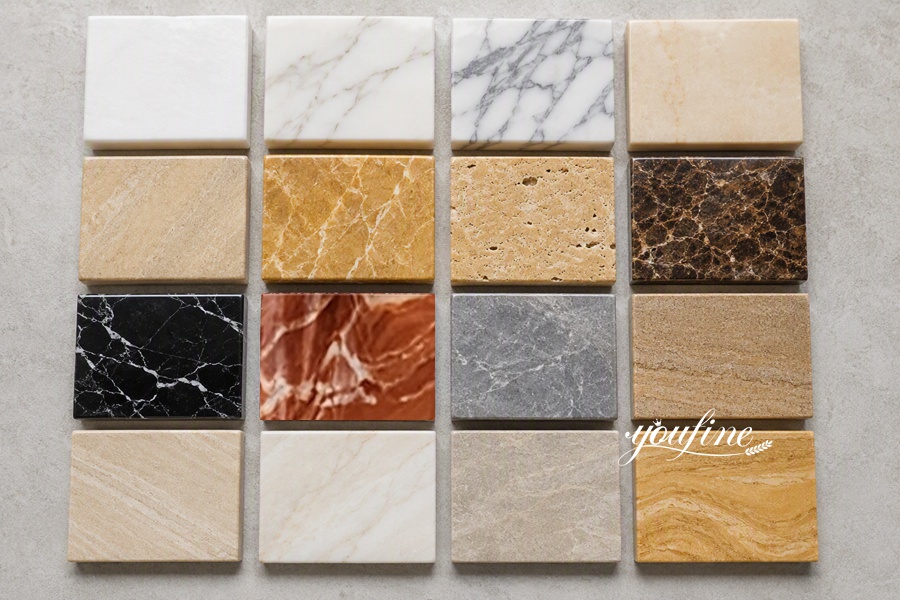
4. How to Choose and Verify the Stone When Buying a Sculpture
What NOT to Do
Do not ask for photos of the raw stone block. A raw block can provide useful information, but it cannot fully predict how the color, grain, veining, or inclusions will appear across the finished sculpture. As the carver cuts deeper, grain patterns and veining change — sometimes dramatically. A beautiful block surface can hide internal flaws, and a rough-looking surface can yield perfect interior stone.
Do not send a photo of a specific veining pattern and say “I want exactly this veining.” Natural stone varies from block to block. If you send a photo of a particular sculpture and ask for exactly the same veining, the result may not be reproducible.For important projects, ask the carver how the available block will be oriented so that the major veins and color variations work with the sculpture’s design.
What TO Do
1. Ask for photos of finished sculptures made from the same stone type and, ideally, the same grade. This gives you a much better idea of how the material looks after carving and finishing. This is the only reliable way to see what the stone actually looks like after carving and polishing. Pay attention to how the grain interacts with carved details — does it enhance or distract from the form?
2. Ask for the exact stone type, origin, and grade—not simply “white marble” or “Italian marble.”For Carrara, ask what specific material or grade is being proposed. For Chinese marble, ask for the commercial stone name and, when relevant, the quarry or source information.
3. For large or high-value projects, consider requesting a representative sample or a sample from the proposed material.
4. For custom sculptures, progress photos from the rough-carving stage can be especially useful. At this stage, some internal grain, veining, or inclusions may become more visible before the final surface is completed.
5. Tell the seller exactly how the sculpture will be used: indoor or outdoor, approximate size, climate, direct sun or shade, fountain or dry sculpture, and the level of detail required.
The more context you provide, the more useful a material recommendation can be.
6. Ask the carver: “How much will the veining vary across different parts of the sculpture?” A skilled carver can predict this. They might say “The veining will be heavier around the base” or “The face should come out clean.” Ask how the natural veining is expected to move across the sculpture and whether the carver can orient the block to achieve the desired visual effect.
5. Final Recommendations: Which Stone Should You Choose?
| Your Situation | Our Recommendation |
| Large outdoor sculpture (2m+, garden, estate) | Masha White — bright, dense, weathers beautifully, best value for big white pieces |
| Outdoor figurative sculpture (angels, classical figures, animals) | Guangxi White, or high-quality Fangshan White if you want finer detail |
| Indoor sculpture with a real budget | Carrara — the sweet spot for detail and prestige |
| Architectural elements (columns, benches,gazebos) | Egyptian Beige or Spanish Beige (Crema Marfil) — warm, durable, timeless |
| Color matching &decoration (borders, panels, inlays, accents) | Rosin Yellow, Chicken Blood Red, Coffee Net (Emperador), and other accent stones— mixed into a white or beige composition they create the kind of layered, custom look money can’t buy off the shelf |
| Modern / contemporary statement piece | Nero Marquina (Black & White Root) or Grey Stone |
| Outdoor sculpture where long-term durability is the priority | Granite is worth considering, particularly for monuments and large exposed pieces. |
These recommendations are starting points, not fixed rules. The specific stone grade, climate, sculpture design, size, finish, and installation should all be considered before making a final selection.
And if you are still not sure? Just contact us — tell us what you are building, where it will live, and your budget. We do this every day.
6. Pitfall Guide: Natural Marble vs. Engineered or Cast Materials
This is the most expensive mistake we see — and the easiest to avoid once you know the difference.
What Is Artificial Marble?
The term “artificial marble” can refer to several engineered or composite materials. Depending on the product, these may contain mineral fillers, stone powder, cement, resin, pigments, or other binders rather than being a single block of naturally quarried marble.
Natural vs Artificial Table
| Natural Marble | Engineered / Cast Material | |
| Material | Naturally quarried stone | Manufactured composite or cast material |
| Appearance | Natural variation in color, grain, and veining | May be more uniform or have designed/repeated patterns |
| Carving | Suitable for traditional stone carving | Depends on the specific material; not equivalent to carving natural marble |
| Outdoor performance | Depends on stone type, climate, finish, and installation | Depends heavily on the binder and formulation |
| Repair | Can often be repaired, refinished, or repolished | Repairability varies by material |
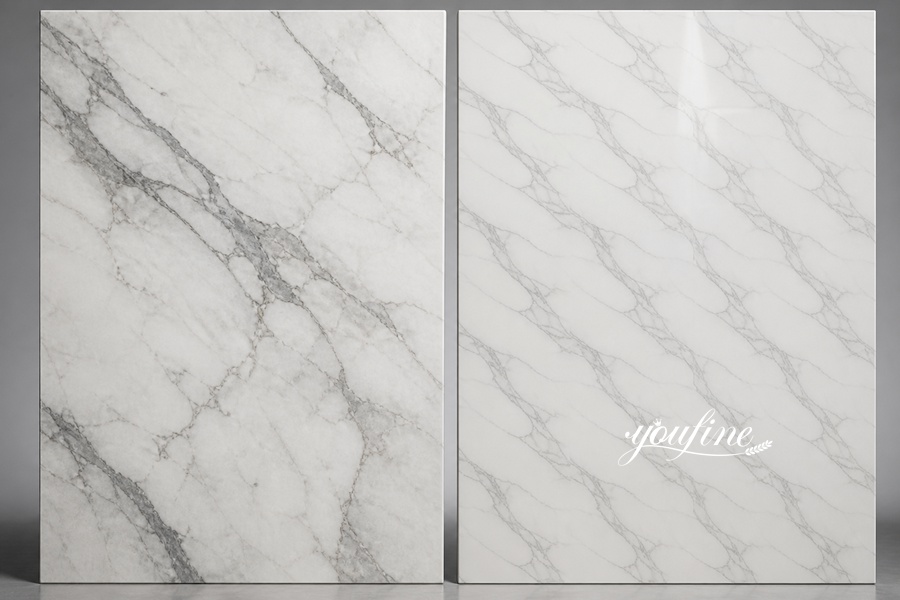
How to Verify What Material You Are Buying
1. Ask for the material specification
Ask whether the sculpture is carved from naturally quarried stone or made from a cast/engineered material.
2. Ask for the exact stone name
“White marble” is not enough. Ask for the commercial stone name and, when relevant, its origin and grade.
3. TAsk for photos of the carving process
Progress photos can help show that the sculpture is being carved from a stone block rather than molded as a finished surface.
4. Ask for a representative sample
For large custom projects, a sample of the proposed material can help you evaluate color, grain, and finish before production.
5. Get the material description in writing
For expensive commissions, confirm the agreed material in your quotation or contract.
The Insider Rule
Both materials have legitimate uses — artificial marble is fine for budget interior countertops and shower walls. For traditionally carved stone sculpture, naturally quarried stone offers the material character, grain, and carving process that define the finished piece.
A sculpture is carved from the inside out; a molded panel is a surface. If your piece must last for generations, hold out for the real thing.
Not Sure Which Stone Is Right for Your Sculpture?
Tell us:
- what you are creating
- where it will be installed
- approximate size
- preferred color or style
- whether it will be indoors or outdoors
- your target budget
We can help you compare suitable stone options and show examples made from the same material.
Contact us to discuss your project.